A better way for NOS customers to understand and analyse their telco invoice
Cllient
NOS
My role
UX/UI designer
Team
6 people
Year
2021
01
Overview
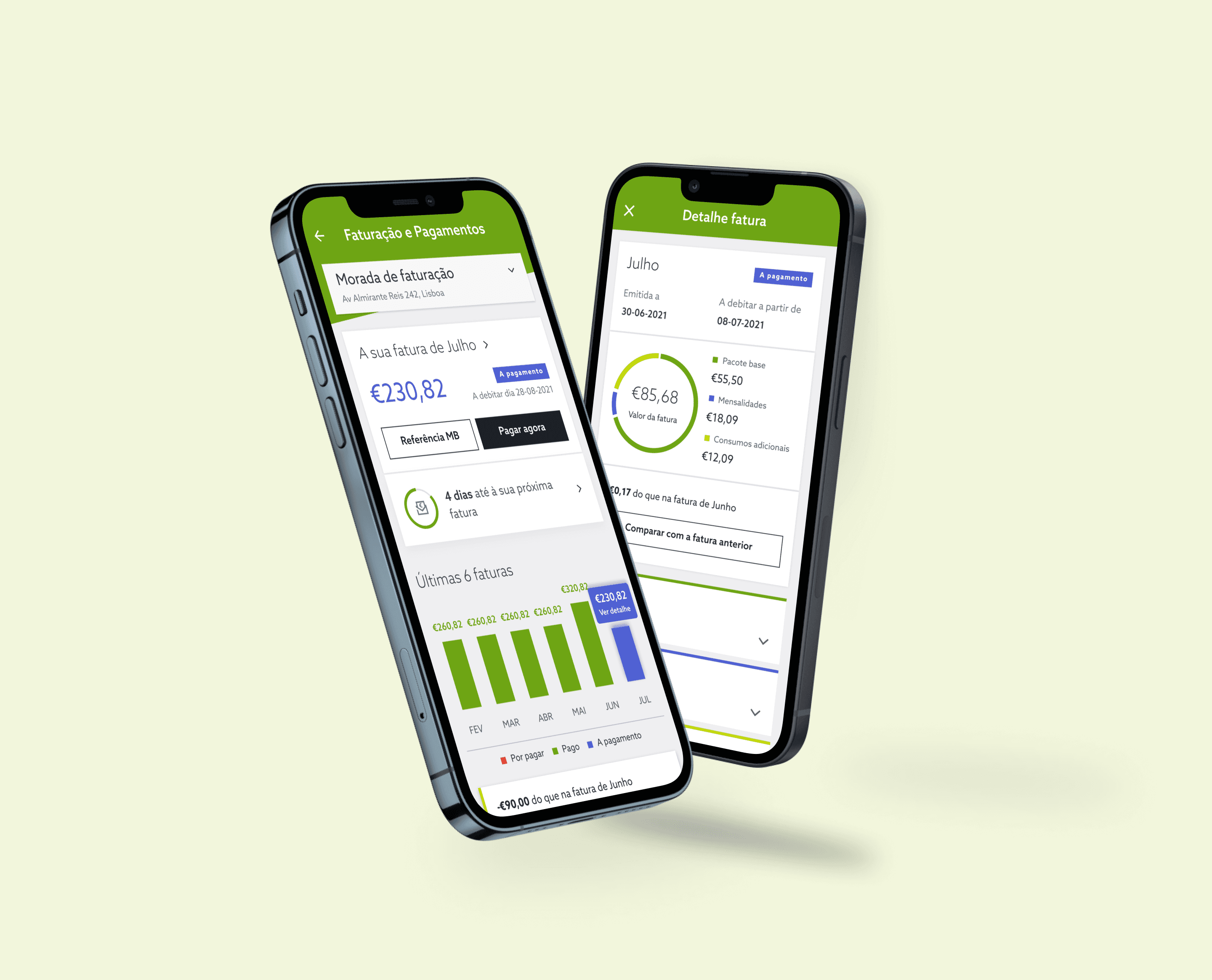
NOS is a Portuguese telecom operator serving 3.5 million clients. The contact center handles 82,000 monthly billing and payment-related calls, with 30% about invoice totals, 4% about payment cycles, and 15% about incorrect invoice format changes.
02
Challenge
Analyzing recorded customer calls, we identified key user pain points and formulated a central question to address these challenges.
"Using the customer service app as the primary digital touchpoint, how can we design a seamless, intuitive, and customizable experience that empowers users to forecast and understand their payable amounts while efficiently managing their billing and payment data?"
03
First round
The workshop brought together a cross-functional team from different areas of the company. As a UX/UI designer, my role involved facilitating the workshop in order to promote discussion, and contributing with previous insights from my daily work on the product.
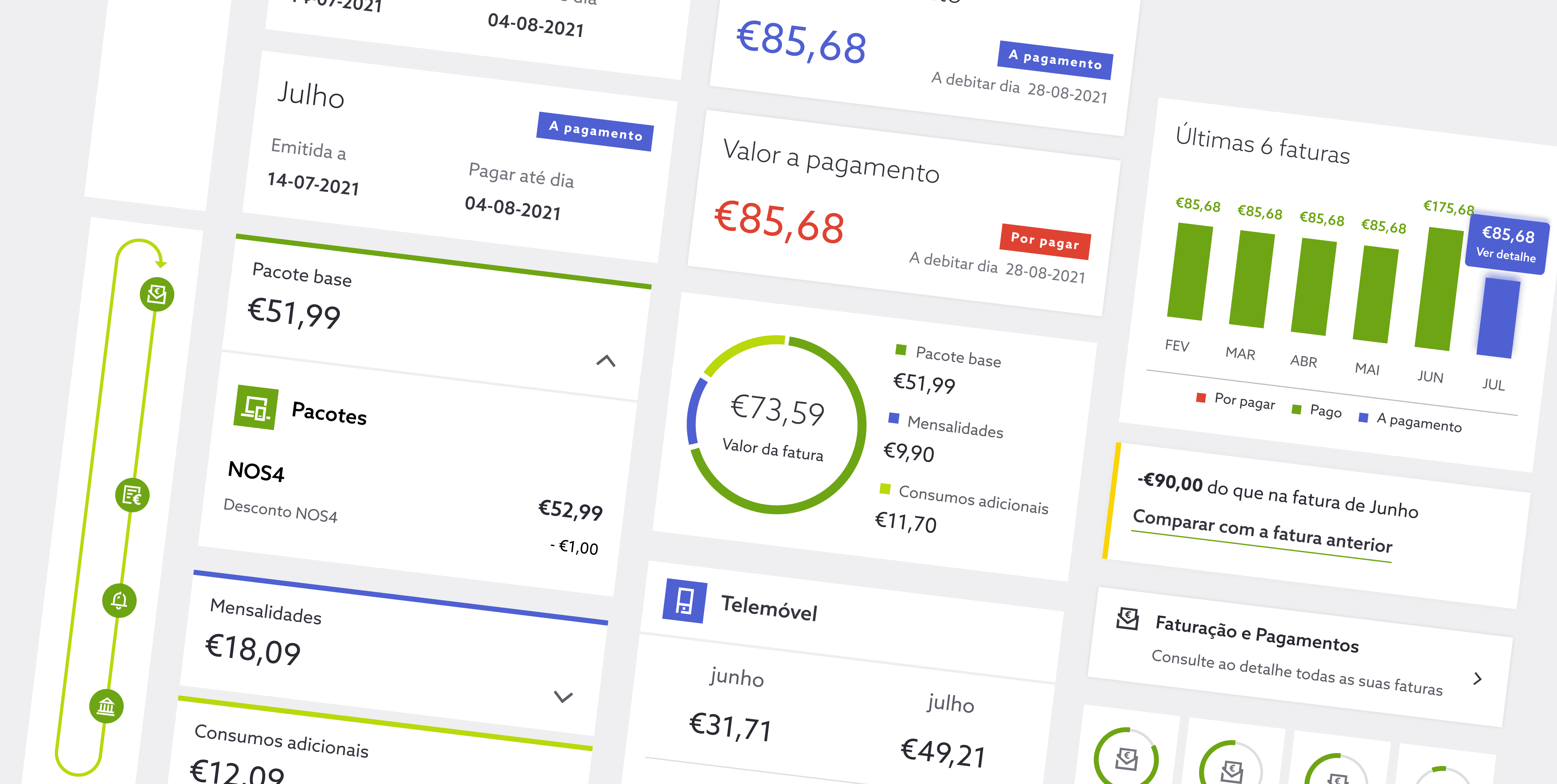
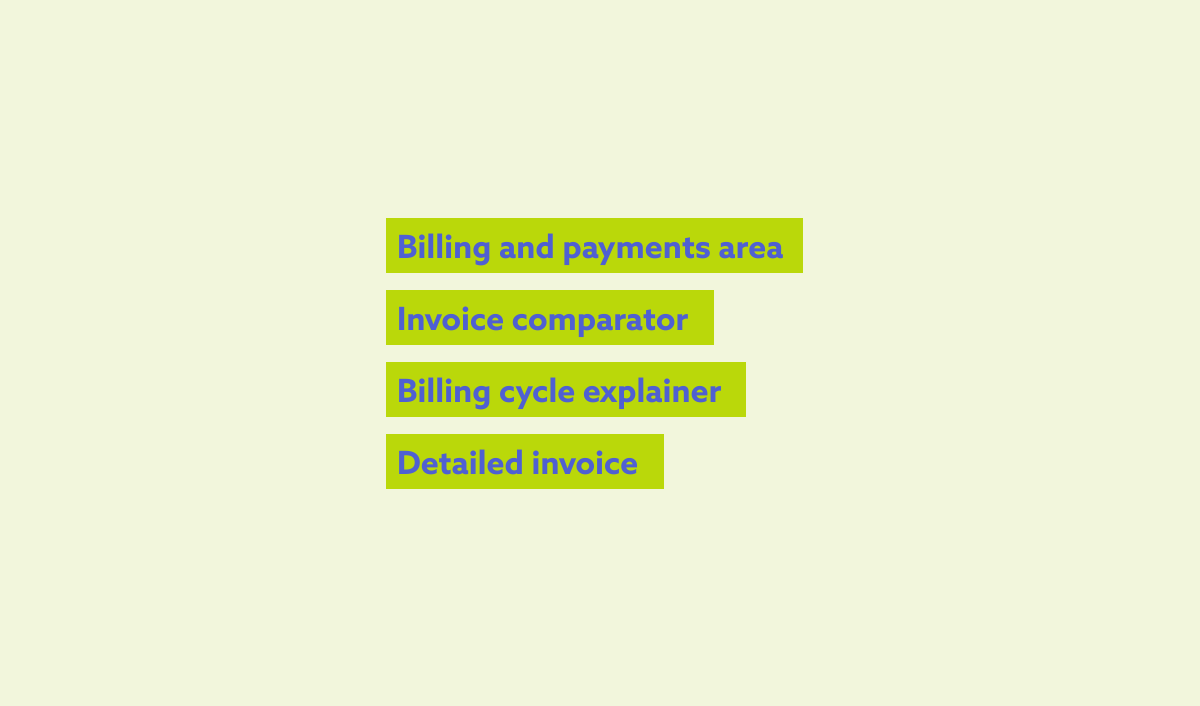
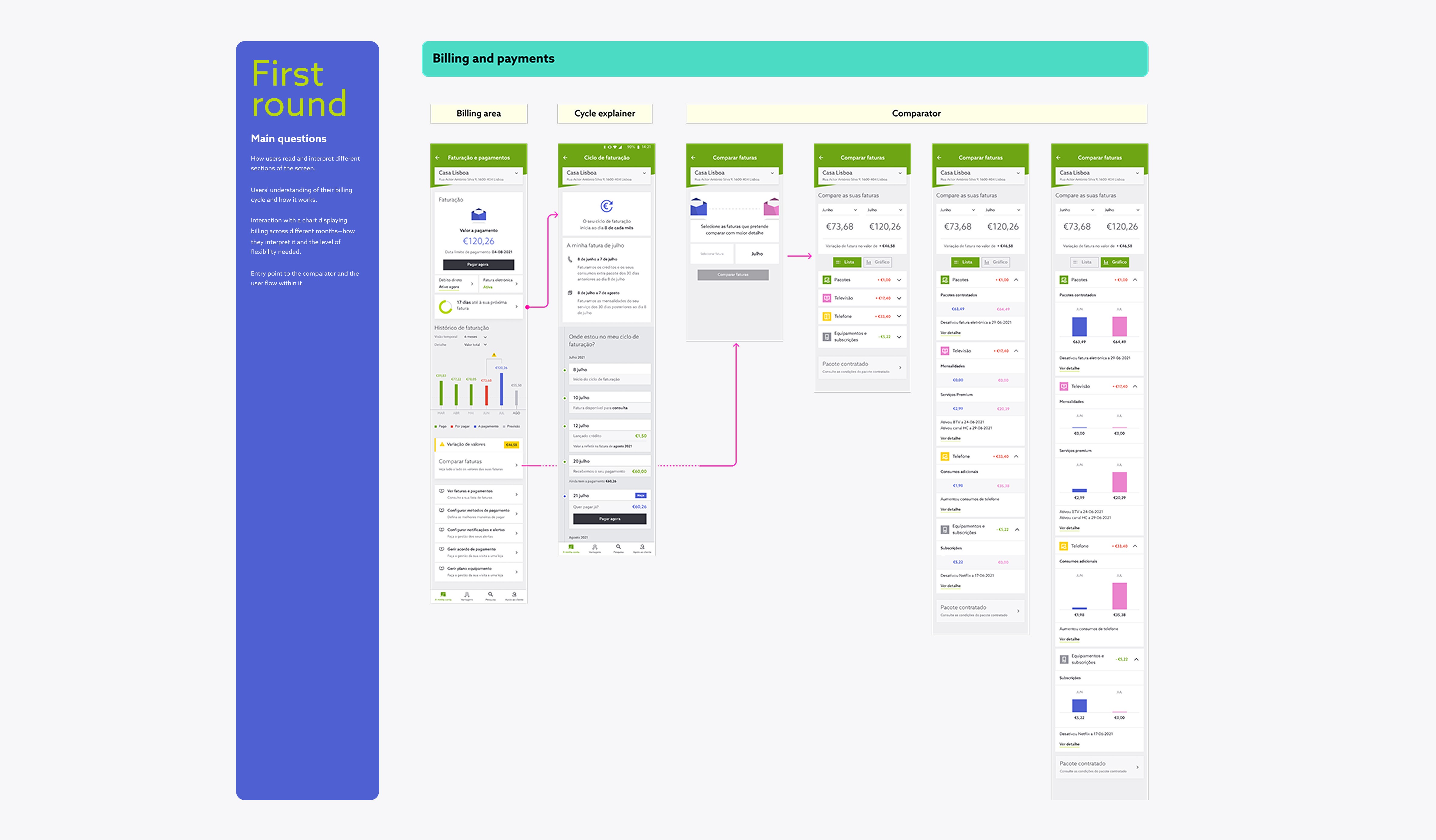
In this first round, we ideated and tested the access points to the billing area, focusing on how users interpret the different sections. We also conducted an initial test of the comparator, gathering valuable feedback to guide potential iterations.
Additionally, we used this session to explore how customers mentally divide their invoices. Understanding their natural categorization process provided valuable insights into how we can structure and present billing information more intuitively in the dedicated screen for detailed invoice.
04
User's feedback
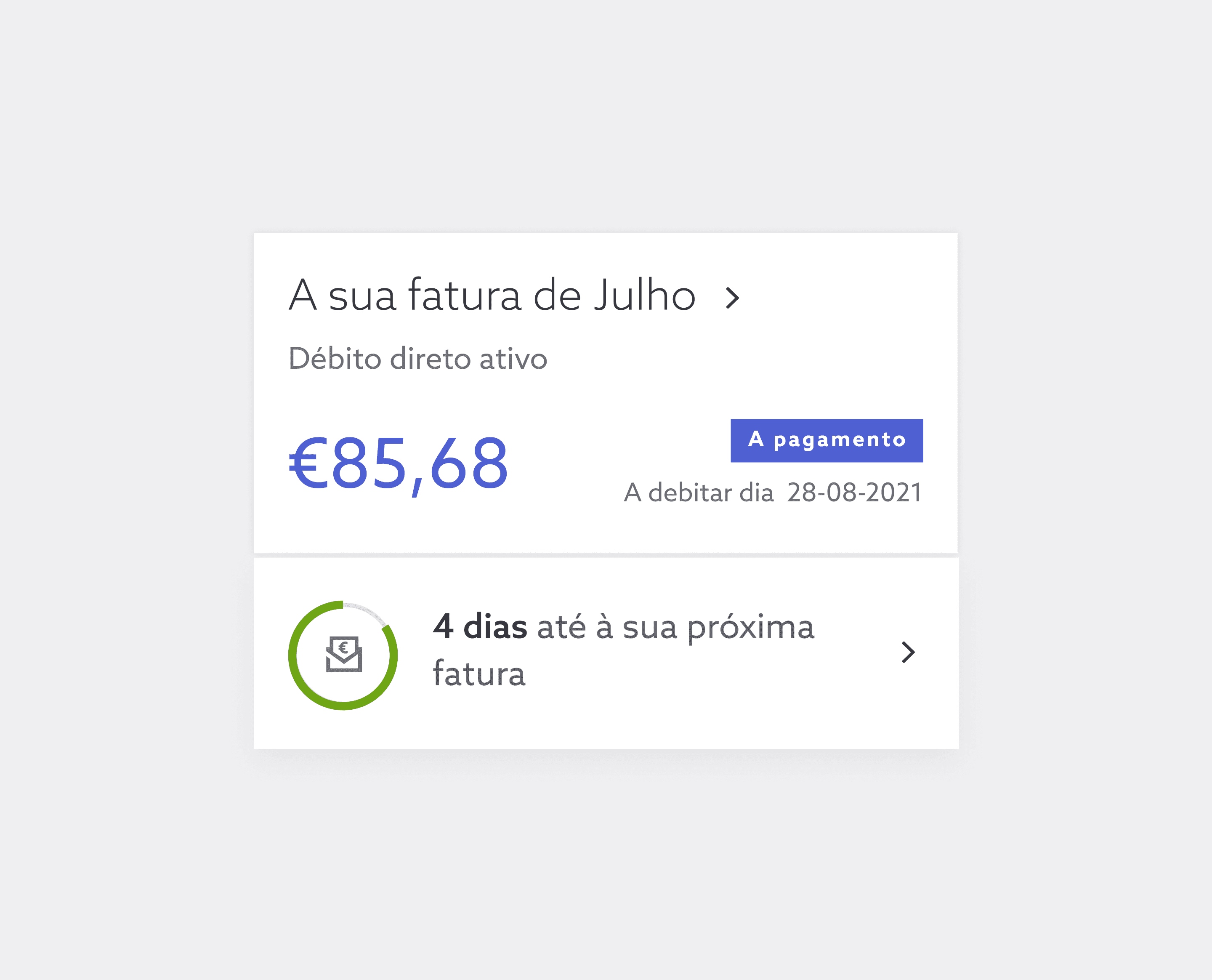
Users found the invoice card too large, taking up valuable space, and suggested a "less is more" approach to reduce distractions.
The bar chart in the main area was helpful, but users expected a more dynamic experience. The chart variation alert lacked perceived value, while the chart caption was clear.
The comparator screen, as designed, was not feasible, and users questioned if the detailed sentence should be moved up. Most preferred the list view, but it needed refinement based on IT feasibility.
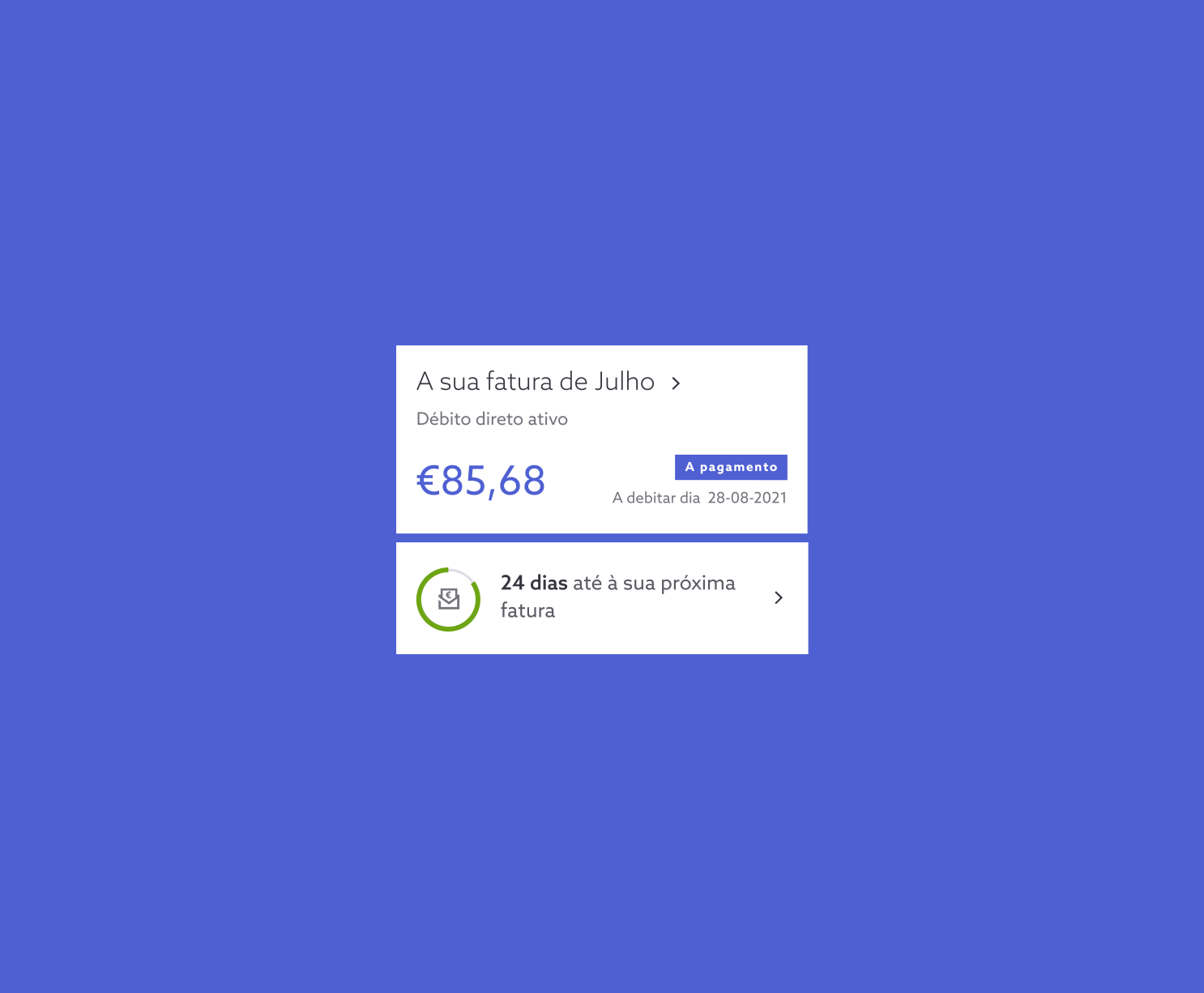
The billing period was understandable, though users suggested shortening the text and making it feel more cycle-like. Concerns were also raised about color choices for accessibility and whether the e-invoice and direct debit buttons should remain attached to the invoice card.
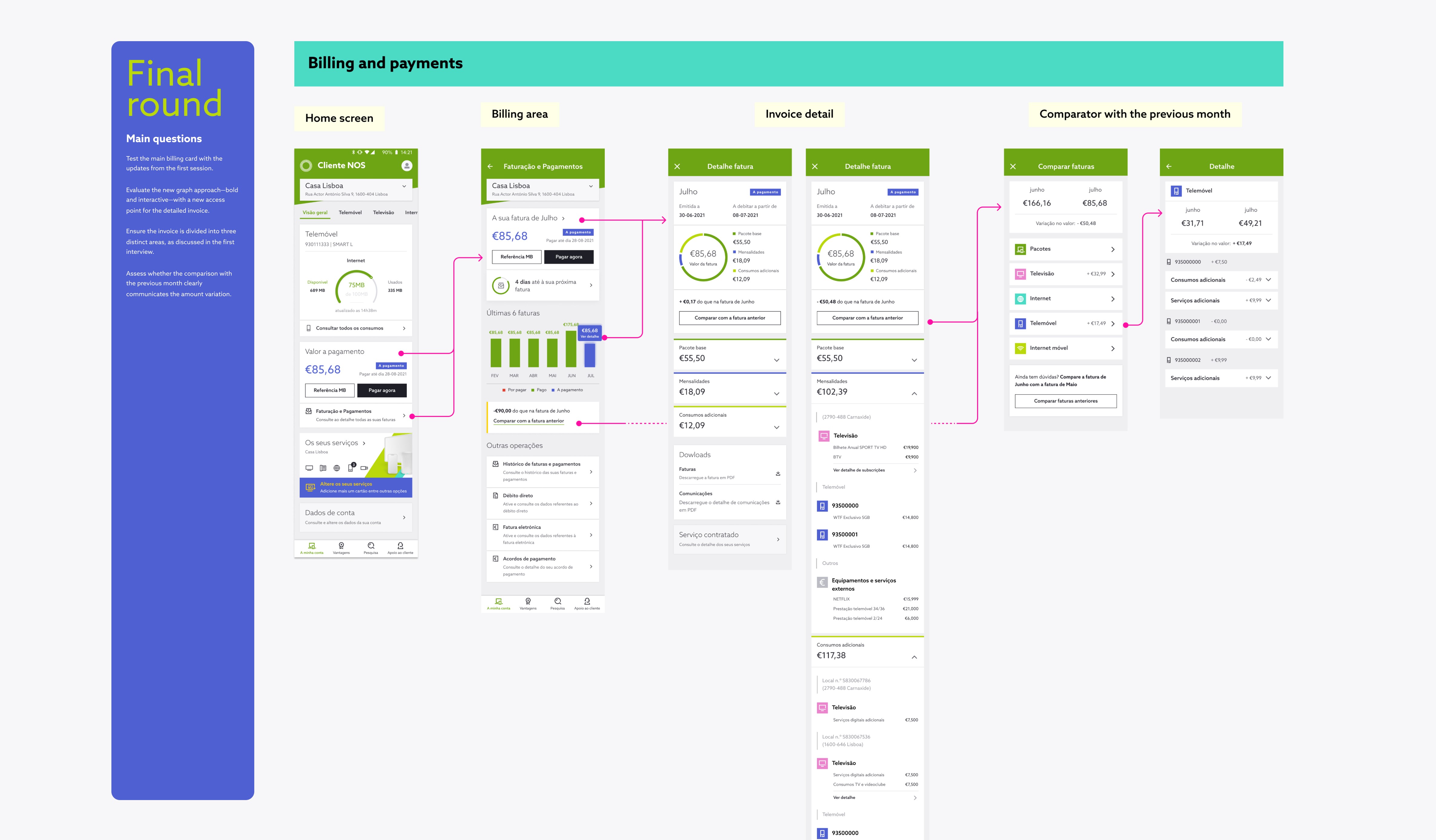
All the changes from the previous session were understood, and the testers successfully achieved the proposed tasks.
· How to pay invoice
· How to access to the detailed invoice
· Interpretation of the detailed invoice
· Compare with the previous invoice to identify possible issues
The main flow and the value proposition were there.
They were smoothly tested and validated, with clear design documentation and seamless developer alignment contributing to a successful implementation, improving the experience for NOS customers.
05
Impact and results
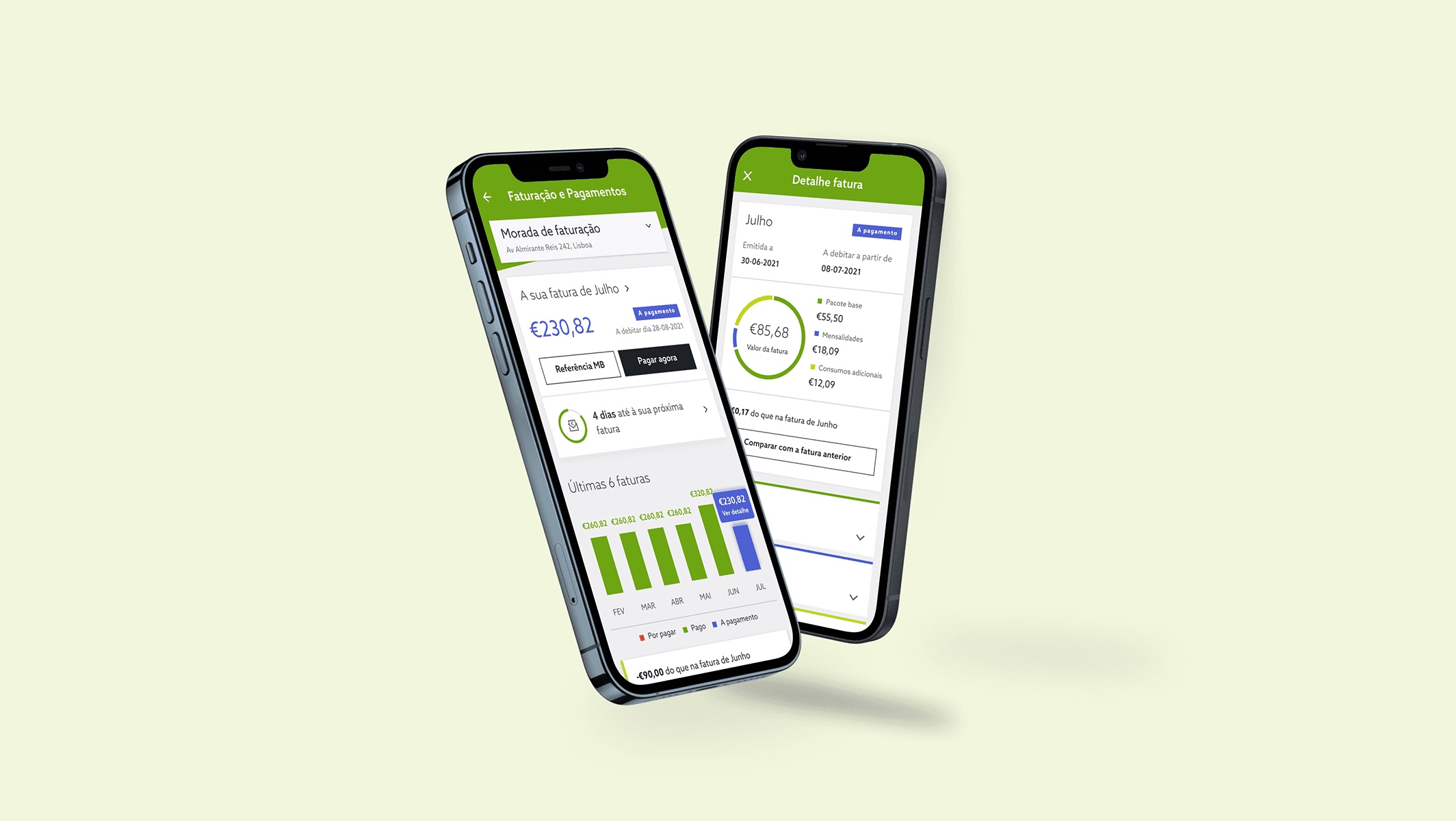
Since its Q1 2022 launch, the billing area has grown +20% per quarter, reaching 713K accesses in Q3.
The detailed invoice, introduced in September 2022, saw 184K accesses (+17%), while the invoice comparator quickly gained 27K accesses.
These results confirm strong adoption, driven by improved transparency and usability.
02
01
Challenge
Overview
By analyzing recorded customer calls, we identified key user pain points and formulated a central question to address these challenges.
"Using the customer service app as the primary digital touchpoint, how can we design a seamless, intuitive, and customizable experience that empowers users to forecast and understand their payable amounts while efficiently managing their billing and payment data?"
NOS is a Portuguese telecom operator serving 3.5 million clients.
The contact center handles 82,000 monthly billing and payment-related calls, with 30% about invoice totals, 4% about payment cycles, and 15% about incorrect invoice format changes.
NOS is a Portuguese telecom operator serving 3.5 million clients.
The contact center handles 82,000 monthly billing and payment-related calls, with 30% about invoice totals, 4% about payment cycles, and 15% about incorrect invoice format changes.
02
Challenge
By analyzing recorded customer calls, we identified key user pain points and formulated a central question to address these challenges.
"Using the customer service app as the primary digital touchpoint, how can we design a seamless, intuitive, and customizable experience that empowers users to forecast and understand their payable amounts while efficiently managing their billing and payment data?"
By analyzing recorded customer calls, we identified key user pain points and formulated a central question to address these challenges.
"Using the customer service app as the primary digital touchpoint, how can we design a seamless, intuitive, and customizable experience that empowers users to forecast and understand their payable amounts while efficiently managing their billing and payment data?"
Analyzing recorded customer calls, we identified key user pain points and formulated a central question to address these challenges.
"Using the customer service app as the primary digital touchpoint, how can we design a seamless, intuitive, and customizable experience that empowers users to forecast and understand their payable amounts while efficiently managing their billing and payment data?"
03
Problem
First round
The contact center handles 82,000 monthly billing and payment-related calls, with 30% about invoice totals, 4% about payment cycles, and 15% about improper invoice format changes.
The workshop brought together a cross-functional team from different areas of the company. As a UX/UI designer, my role involved facilitating the workshop in order to promote discussion, and contributing with previous insights from my daily work on the product.
In this first round, we ideated and tested the access points to the billing area, focusing on how users interpret the different sections. We also conducted an initial test of the comparator, gathering valuable feedback to guide potential iterations.
Additionally, we used this session to explore how customers mentally divide their invoices. Understanding their natural categorization process provided valuable insights into how we can structure and present billing information more intuitively in the dedicated screen for detailed invoice.
03
First round
The workshop brought together a cross-functional team from different areas of the company. As a UX/UI designer, my role involved facilitating the workshop in order to promote discussion, and contributing with previous insights from my daily work on the product.
In this first round, we ideated and tested the access points to the billing area, focusing on how users interpret the different sections. We also conducted an initial test of the comparator, gathering valuable feedback to guide potential iterations.
Additionally, we used this session to explore how customers mentally divide their invoices. Understanding their natural categorization process provided valuable insights into how we can structure and present billing information more intuitively in the dedicated screen for detailed invoice.
04
First round
User's feedback
The workshop brought together a cross-functional team from different areas of the company. As a UX/UI designer, my role involved facilitating the workshop in order to promote discussion, and contributing with previous insights from my daily work on the product.
In this first round, we ideated and tested the access points to the billing area, focusing on how users interpret the different sections. We also conducted an initial test of the comparator, gathering valuable feedback to guide potential iterations.
Additionally, we used this session to explore how customers mentally divide their invoices. Understanding their natural categorization process provided valuable insights into how we can structure and present billing information more intuitively in the dedicated screen for detailed invoice.
Users found the invoice card too large, taking up valuable space, and suggested a "less is more" approach to reduce distractions.
The bar chart in the main area was helpful, but users expected a more dynamic experience. The chart variation alert lacked perceived value, while the chart caption was clear.
The comparator screen, as designed, was not feasible, and users questioned if the detailed sentence should be moved up. Most preferred the list view, but it needed refinement based on IT feasibility.
The billing period was understandable, though users suggested shortening the text and making it feel more cycle-like. Concerns were also raised about color choices for accessibility and whether the e-invoice and direct debit buttons should remain attached to the invoice card.
04
User's feedback
Users found the invoice card too large, taking up valuable space, and suggested a "less is more" approach to reduce distractions.
The bar chart in the main area was helpful, but users expected a more dynamic experience. The chart variation alert lacked perceived value, while the chart caption was clear.
The comparator screen, as designed, was not feasible, and users questioned if the detailed sentence should be moved up. Most preferred the list view, but it needed refinement based on IT feasibility.
The billing period was understandable, though users suggested shortening the text and making it feel more cycle-like. Concerns were also raised about color choices for accessibility and whether the e-invoice and direct debit buttons should remain attached to the invoice card.
Users found the invoice card too large, taking up valuable space, and suggested a "less is more" approach to reduce distractions.
The bar chart in the main area was helpful, but users expected a more dynamic experience. The chart variation alert lacked perceived value, while the chart caption was clear.
The comparator screen, as designed, was not feasible, and users questioned if the detailed sentence should be moved up. Most preferred the list view, but it needed refinement based on IT feasibility.
The billing period was understandable, though users suggested shortening the text and making it feel more cycle-like. Concerns were also raised about color choices for accessibility and whether the e-invoice and direct debit buttons should remain attached to the invoice card.
All the changes from the previous session were understood, and the testers successfully achieved the proposed tasks.
· How to pay invoice
· How to access to the detailed invoice
· Interpretation of the detailed invoice
· Compare with the previous invoice to identify possible issues
The main flow and the value proposition were there.
They were smoothly tested and validated, with clear design documentation and seamless developer alignment contributing to a successful implementation, improving the experience for NOS customers.
All the changes from the previous session were understood, and the testers successfully achieved the proposed tasks.
· How to pay invoice
· How to access to the detailed invoice
· Interpretation of the detailed invoice
· Compare with the previous invoice to identify possible issues
The main flow and the value proposition were there.
They were smoothly tested and validated, with clear design documentation and seamless developer alignment contributing to a successful implementation, improving the experience for NOS customers.
01
05
User's feedback
Impact and results
All the changes from the previous session were understood, and the testers successfully achieved the proposed tasks. The main flow and the value proposition were there.
They were smoothly tested and validated, with clear design documentation and seamless developer alignment contributing to a successful implementation, improving the experience for NOS customers.
Since its Q1 2022 launch, the billing area has grown +20% per quarter, reaching 713K accesses in Q3.
The detailed invoice, introduced in September 2022, saw 184K accesses (+17%), while the invoice comparator quickly gained 27K accesses.
These results confirm strong adoption, driven by improved transparency and usability.
Since its Q1 2022 launch, the billing area has grown +20% per quarter, reaching 713K accesses in Q3.
The detailed invoice, introduced in September 2022, saw 184K accesses (+17%), while the invoice comparator quickly gained 27K accesses.
These results confirm strong adoption, driven by improved transparency and usability.
A better way for NOS customers to understand and analyse their telco invoice
A better way for NOS customers to understand and analyse their telco invoice
Cllient
NOS
My role
UX/UI designer
Team
6 people
Year
2021
SOLVING
together
antmgarcia@gmail.com
Mobile
+351 919 050 695
SOLVING
together
antmgarcia@gmail.com
+351 919 050 695
SOLVING
together